
How Much Does a Business Website Cost in 2026? (Per-Country Guide)
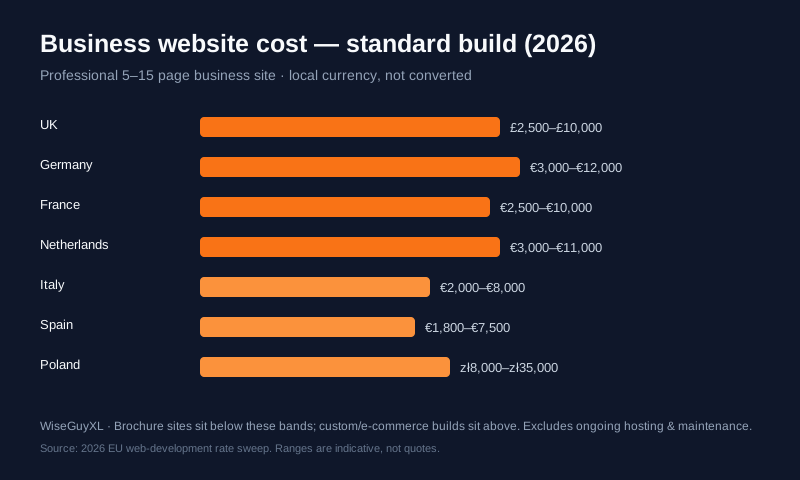
Quick answer: In 2026, a professional small-business website (5–15 pages, custom design, mobile-first, compliant) costs roughly £2,500–£10,000 in the UK, €1,800–€12,000 across the eurozone, and zł8,000–zł35,000 in Poland. A simple brochure or template site can be much cheaper (£500–£2,000 / €500–€2,500), while a custom or e-commerce build runs well above these bands. Hosting, maintenance and compliance are ongoing costs on top. Below we break it down by build type and show real rate bands for seven European markets.
“How much does a website cost?” has the same honest answer as “how much does a house cost?” — it depends entirely on what you’re building. A three-page template site and a custom, multilingual, accessible, GDPR-compliant business site are different products at different prices.
The four build types (and what they cost)
| Build type | Eurozone range | Timeline | Best for |
|---|---|---|---|
| DIY builder (Wix, Squarespace, WordPress.com) | €0–€400/yr | Days | Solo founders testing an idea |
| Template / brochure site | €500–€2,500 | 1–3 weeks | Small local businesses |
| Custom business website | €3,000–€12,000 | 4–10 weeks | Established SMEs that need to convert |
| Custom / e-commerce / web app | €12,000–€60,000+ | 2–6 months | Shops, portals, lead engines |
Most established European small and mid-sized businesses land in the custom business website band, because that’s the level where design, accessibility, performance and compliance are all done properly rather than bolted on later.
What actually drives the price
Design. A bespoke design costs more than a customised template but does more work: it builds trust, differentiates you, and is tuned to convert. Design is not decoration — it’s how the site works.
Number of pages and templates. Ten unique page layouts cost far more than one layout repeated across ten pages.
Functionality. A contact form is trivial. Bookings, payments, member logins, multilingual content, CRM integrations and product catalogues each add real engineering time.
Content. Copywriting, photography and translation are frequently underestimated. A multilingual EU site needs professional localisation, not machine translation, in each market.
Compliance and accessibility. In the EU this is no longer optional (see below), and building it in from the start is cheaper than retrofitting.
Per-country rate bands (2026)
Quoted in each market’s own currency — don’t convert £ to € one-for-one; local labour markets set these rates.
- United Kingdom — £2,500–£10,000 for a standard business site; London agencies at the top, regional and freelance lower (£300–£600/day). UK GDPR + PECR apply to forms and cookies.
- Germany — €3,000–€12,000. The priciest eurozone market. DSGVO, §25 TDDDG for cookies, and the Impressumspflicht (§5 DDG) — a legally required imprint — apply to every German business site. The BFSG (German transposition of the EAA) mandates accessibility.
- France — €2,500–€10,000. Paris above regional agencies. RGPD/CNIL for data and cookies, plus the RGAA accessibility standard.
- Netherlands — €3,000–€11,000. Mature, English-fluent market close to German rates. AVG + Telecomwet (art. 11.7a) cookie rules.
- Italy — €2,000–€8,000. Milan premium; lower elsewhere. GDPR under the Garante; Legge Stanca for accessibility.
- Spain — €1,800–€7,500. Among the more affordable Western-European markets. RGPD + LOPDGDD + art. 22 LSSI-CE (AEPD).
- Poland — zł8,000–zł35,000. Lowest nominal rates; a common near-shoring hub. RODO + PKE (UODO).
The EU compliance layer (all markets)
Three requirements now apply to virtually every business website in the EU/UK and should be scoped into the build, not discovered later:
- European Accessibility Act — in force since June 2025, requiring WCAG 2.1 AA for a wide range of business sites (e-commerce, banking, transport, and more). Retrofitting accessibility is expensive; building to standard is not.
- Cookie consent + Google Consent Mode v2 — mandatory across the EEA and UK since March 2024 for anyone using Google Ads or Analytics. A compliant consent banner is part of the build.
- Omnibus Directive — bans fake and undisclosed-incentivised reviews EU-wide, which matters if your site displays testimonials or ratings.
Local payment methods matter (if you sell)
If the site takes payments, budget for the methods your customers actually use: iDEAL in the Netherlands, BLIK in Poland, Bancontact in Belgium, Cartes Bancaires in France, Bizum in Spain, Satispay in Italy, and Kauf auf Rechnung / SEPA in Germany. A checkout that only offers international cards leaves money on the table in every one of these markets.
Don’t forget ongoing costs
The build is a one-off; running the site is not. Budget €10–€50/month for hosting, €50–€300/month for maintenance and security updates, plus domain renewal and any premium plugins or licences. A cheap build with no maintenance plan is a false economy — an unpatched site is a security and compliance risk.
FAQ
Why is there such a huge price range? Because “website” covers everything from a one-page template to a bespoke multilingual platform. Match the build type to your business goal.
Is a cheap template site ever the right choice? Yes — for a brand-new micro-business testing demand. Upgrade once the business is proven.
Freelancer or agency? Freelancers are cheaper (from €300/day equivalent) and great for smaller sites; agencies cost more but bundle design, development, content, accessibility and compliance.
How long does a business website take? A brochure site: 1–3 weeks. A custom business site: 4–10 weeks. E-commerce or web apps: 2–6 months.
Sources
- 2026 EU web-development rate sweep (WiseGuyXL): UK, DE, FR, ES, IT, NL, PL bands.
- DMC Kreatif — EU website cost by country (2026); Sunbytes — EU development cost benchmarks.
- European Accessibility Act (in force June 2025, WCAG 2.1 AA); Google Consent Mode v2 (EEA+UK, March 2024); Omnibus Directive.
Attributed quote (verified): “Design is not just what it looks like and feels like. Design is how it works.” — Steve Jobs, The New York Times, 2003.
CTA
Planning a new business website in one or several European markets? WiseGuyXL builds compliant, conversion-focused sites and has delivered 341% organic growth across 30+ projects in 9+ markets. We’ll give you an honest scope and a real number before you commit. Read more insights on our blog »
Related: How to make your website convert · What does an SEO agency cost?