
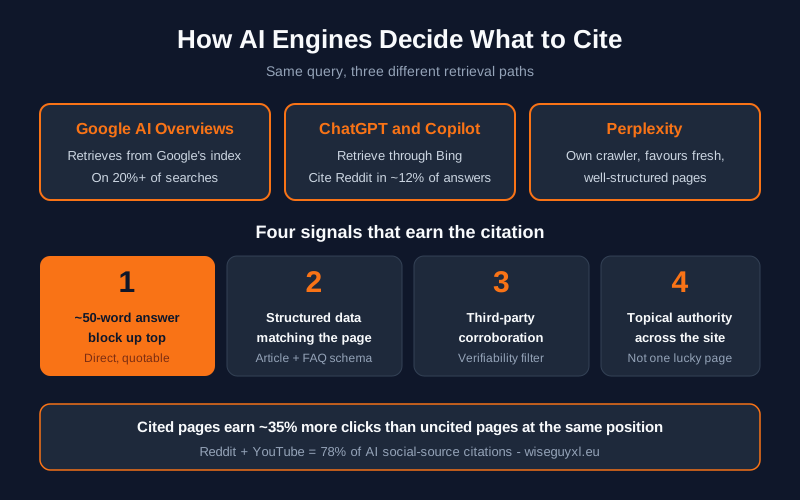
Quick answer: To get cited by ChatGPT and Google AI Overviews, give each key page a direct ~50-word answer near the top, mark it up with structured data that matches the visible text, back your claims with third-party sources the engine can verify, and build genuine topical authority across your whole site — not one lucky page. Cited pages earn roughly 35% more clicks than uncited pages at the same position.
Why citations are the new ranking
For two decades, SEO chased one thing: a blue link near the top of Google. In 2026 that link is often no longer the destination. About 68% of US searches now end without a click to the open web, and Google AI Overviews appear on more than 20% of queries, dropping click-through on the results beneath them. The question has shifted from *”do I rank?”* to *”am I the source the AI quotes?”*
Being cited is measurable and valuable. Pages referenced inside an AI Overview receive around 35% more clicks than uncited pages sitting at the same position — the citation, not the ranking, is doing the work. So the discipline that used to be called SEO now has a sibling: AEO/GEO (Answer Engine Optimization / Generative Engine Optimization), the practice of getting picked, quoted and linked by generative engines.
Each engine retrieves differently
There is no single “AI search” to optimise for. The three systems that matter in Europe pull their sources from three different places, and that changes your tactics.
Google AI Overviews are generated from Google’s own index. If you already rank on page one for a query and your page answers it cleanly, you are a strong candidate — AI Overviews lean on pages Google already trusts, and they favour sites with proven topical authority over one-off articles.
ChatGPT and Microsoft Copilot retrieve through Bing. That makes Bing indexation and Bing Webmaster Tools genuinely worth your time again — a page invisible to Bing is invisible to ChatGPT’s browsing. ChatGPT also leans heavily on community sources: it cites Reddit in roughly 12% of its US answers.
Perplexity runs its own crawler and shows a bias toward recently updated, well-structured pages. Freshness and clean formatting move the needle here more than raw domain age.
The four signals that earn the citation
Across all three engines, the same four signals keep separating cited pages from ignored ones.
1. A direct ~50-word answer block. Put a self-contained, quotable answer near the top of the page, phrased as a complete statement rather than a teaser. Engines lift passages they can drop into an answer without editing. Follow it with FAQ-style chunks — one question, one clean answer — so the page reads as a set of extractable units.
2. Structured data that matches the page. Article and FAQPage schema tell an engine what your content *means*. As Google’s John Mueller has stressed, your markup must describe what is actually visible on the page — schema that claims things the reader can’t see is a liability, not a shortcut. In 2026, matching structured data is one of the clearest authority signals you can send.
3. Third-party corroboration. AI Overviews run a verifiability filter that cross-references your claims against trusted independent sources. A statistic with a named, linkable source survives that filter; an unsupported assertion is quietly dropped. Cite primary research, name your sources, and link them.
4. Topical authority, site-wide. Engines prefer sites that demonstrably own a subject over a single page that happens to mention it. Higher-authority domains are dramatically more likely to be cited — analyses put sites with 32,000+ referring domains at roughly 3.5× the citation rate of low-authority peers. You build that with clusters of interlinked pages, not isolated posts.
What to optimise for each engine
| Engine | Retrieves from | What moves citation | Your priority |
|---|---|---|---|
| Google AI Overviews | Google index | Page-one relevance + topical authority | Rank first, then add answer blocks + schema |
| ChatGPT / Copilot | Bing index | Bing indexation + community mentions | Verify Bing coverage; earn Reddit/forum presence |
| Perplexity | Own crawler | Freshness + clean structure | Update regularly; tighten HTML and headings |
| Gemini | Google ecosystem | E-E-A-T + entity clarity | Strengthen author, brand and entity signals |
The social-citation layer: Reddit and YouTube
Answer engines lean on user-generated platforms far more than most brands expect. Reddit and YouTube together account for about 78% of the social-media sources AI engines cite — Reddit at roughly 46% and YouTube at roughly 32%. Engines parse a Reddit thread as a Q&A pair: the title is the question, the top-upvoted comment is the cited answer. That means a genuinely helpful, upvoted contribution in a relevant subreddit — or a well-titled, well-chaptered YouTube explainer — can put your expertise into AI answers even when your own page isn’t the one quoted. Participate honestly; astroturfing gets detected and burns the account.
The EU layer: transparency and language
European brands carry an extra layer. The EU AI Act is phasing in transparency obligations through 2025–2026: AI-generated and AI-assisted content, and interactions with AI systems, increasingly need to be disclosed. Publishing your own content with a clear AI-assistance disclosure (as this article does) is both good practice and increasingly expected.
Language is the second EU-specific lever. An engine answering a German query cites German sources; a Dutch query pulls Dutch pages. If you serve seven markets, citation-worthiness has to be earned in each language natively — a translated page rarely carries the local phrasing, sources and authority that a localised one does. That is exactly why WiseGuyXL publishes each topic natively in seven languages rather than machine-translating one.
How to measure AI visibility
You cannot manage what you don’t track. Move beyond rank tracking to citation tracking: monitor how often ChatGPT, Perplexity, Gemini and AI Overviews mention your brand, which pages they quote, and your share of voice against competitors — per engine and per language. Run a fixed set of prompts monthly and log who gets cited. When your answer block gets lifted verbatim, you’ll see it.
FAQ
How long does it take to get cited? Once a strong page is indexed, AI Overviews and Perplexity can pick it up within days to a few weeks; ChatGPT’s browsing tends to reflect Bing’s index on a similar cadence. Topical authority takes longer — months, not days.
Do I need schema to be cited? It isn’t strictly mandatory — Mueller notes clean semantic HTML can be enough — but matching Article + FAQ schema measurably improves your odds and is low-cost to add.
Does an llms.txt file help? There’s no confirmed evidence that llms.txt drives citations today. Prioritise answer blocks, structured data and authority first.
Will AI search kill my traffic? It changes it. You lose some informational clicks but gain qualified ones: users who click a cited source are often further down the decision path.
Sources
– Popup/position & AI-SEO stat roundups, 2026 (AI Overviews on 20%+ of queries; ~35% click uplift for cited pages).
– SparkToro / Search Engine Land zero-click data 2026 (~68% zero-click, US).
– John Mueller (Google Search Advocate) on AI content and structured data matching visible content.
– Reddit/YouTube AI-citation share analyses, 2024–2026.
“Our systems don’t care if content is created by AI or humans. What matters is whether it’s helpful for users.” — John Mueller, Search Advocate, Google
CTA
Want your pages to be the ones AI engines quote — in every language your customers search in? WiseGuyXL builds AEO/GEO into multilingual content that earns citations across ChatGPT, Perplexity, Gemini and AI Overviews. That approach has driven 341% organic growth across 30+ projects in 9+ markets. Talk to us or read more on the blog. Related: AEO vs SEO: what changes in 2026.
By the WiseGuyXL team. AI-assistance disclosure: this article was researched and drafted with AI assistance and edited by a human before publication, in line with EU AI Act transparency expectations.