
AEO vs SEO in 2026: What Actually Changed (and What to Do About It)
Quick answer: SEO optimises your pages to rank in a list of results and earn the click. AEO — Answer Engine Optimization — structures your content to be quoted by AI answer systems like Google’s AI Overviews, ChatGPT and Perplexity. In 2026 they are not rivals: they share the same technical foundation, and strong SEO makes AEO work. What changed is where the answer appears — increasingly inside the AI response rather than on a page the user clicks. The winning play is to keep ranking and become the source the AI cites.
For a decade the goal was simple: rank on page one, get the click. That contract is loosening. AI Overviews now appear on an estimated 13–15% of searches and climbing, 27.2% of US searches end without any click, and AI-referred sessions jumped 527% year over year in 2025. At the same time, Google still holds roughly 89.85% of the global search market, so classic SEO is very much alive. The task in 2026 is to win both surfaces at once.
What AEO and SEO each actually optimise for
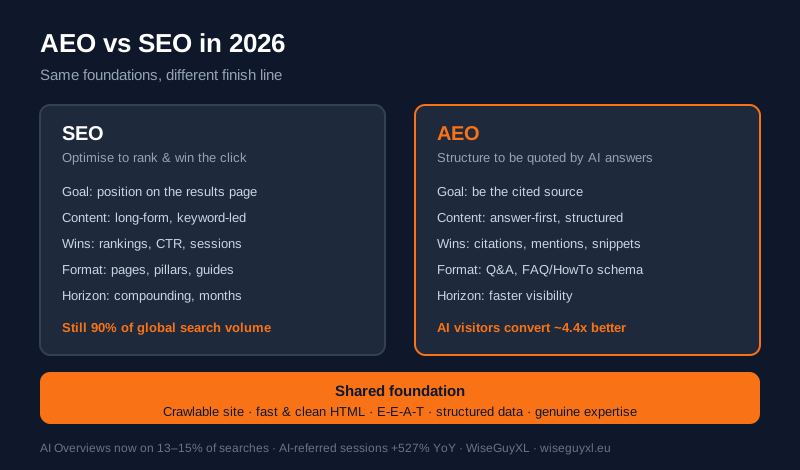
SEO aims to place a page as high as possible in the organic results and win the click. Its levers are keyword research, in-depth content, internal linking, backlinks and technical performance, and its scoreboard is rankings, click-through rate and organic sessions.
AEO aims to make your content the thing an answer engine pulls from when it composes a reply. Its levers are answer-first writing, structured data, clear entity signals and demonstrable expertise, and its scoreboard is citations, brand mentions inside AI answers, and inclusion in featured snippets and voice results.
The crucial 2026 insight is that these run on the same rails. As Andrew Shum, Head of SEO at SeoProfy, puts it, “strong SEO foundations directly improve AEO performance since AI platforms rely on the same technical signals.” An AI engine can only cite a page it can crawl, parse and trust — which is exactly what good SEO delivers.
What actually changed going into 2026
Three shifts matter. First, the answer moved up. Users increasingly get their answer inside the AI Overview or a chatbot reply, so a top-three ranking no longer guarantees a visit — you now compete to be the cited source inside that answer. Second, structured data went from nice-to-have to load-bearing. FAQ, HowTo, Q&A and Article schema help engines interpret and quote your content cleanly. Third, quality of traffic changed. Fewer clicks, but better ones: AI search visitors convert roughly 4.4x better than traditional organic traffic, because someone arriving from an AI recommendation has already been pre-qualified by the answer.
The strategic error is treating this as “SEO is dead.” It isn’t — the AI engines are trained on and cite the open web that SEO builds. The real error would be publishing content no engine can extract a clean answer from.
SEO vs AEO at a glance
| Factor | SEO | AEO |
|---|---|---|
| Goal | Rank in results, win the click | Be the cited source in the answer |
| Content shape | Long-form, in-depth, keyword-led | Answer-first, structured, scannable |
| Format | Pages, pillars, guides | Q&A blocks, FAQ/HowTo schema, lists |
| Success metric | Rankings, CTR, sessions | Citations, mentions, snippet inclusion |
| Time to results | Compounds over months | Can surface faster |
| Still true in 2026 | ~90% of search volume | Fastest-growing discovery channel |
How to do AEO without abandoning SEO
Lead with the answer. Put a direct, 40–60 word response right under each heading, then elaborate. “Answer first, elaborate second” satisfies both the human skim-reader and the AI extractor.
Structure for machines. Use descriptive H2/H3 questions, short paragraphs, tables and lists, and add FAQ, HowTo and Article schema so engines can lift a clean answer. Keep one clear idea per section.
Prove expertise (E-E-A-T). Real author bylines with credentials, first-hand data, citations to primary sources and clear “last updated” dates all raise the odds of being trusted and quoted. AI engines favour content that demonstrates genuine experience.
Build entity clarity. Consistent naming, an “about” page, and structured organisation data help engines understand who you are and what you’re an authority on — the basis for being cited by name.
Keep the SEO fundamentals. A fast, crawlable site with clean HTML, sensible internal links and earned authority is the price of entry for both disciplines. Neglect it and you’re invisible to AI engines and Google alike.
How answer engines actually pick what to cite
It helps to understand the mechanics. When someone asks a question, an answer engine retrieves a set of candidate pages, extracts passages it judges relevant, and composes a response — often citing two to five sources. Your job in AEO is to be one of those extracted passages. Three things raise your odds. Extractability: the engine needs to lift a clean, self-contained answer, so a 40–60 word direct response beats a point buried in paragraph seven. Corroboration: engines favour claims that agree with other trusted sources, so original data and precise, verifiable statements travel further than vague ones. Trust signals: a recognised author, a real organisation, citations to primary sources and a recent update date all push a page up the candidate list.
This is why AEO and SEO reinforce each other rather than compete. The retrieval step leans on the same crawlability, site speed, internal linking and authority that classic SEO builds; the extraction step rewards the clear structure and schema that good content design already encourages. A page that no crawler can reach or parse is invisible to both Google’s ranking and its AI Overview. Build once, well, and you show up in both places.
How to measure AEO (so it isn’t guesswork)
Traditional SEO reporting — rankings, sessions, conversions — still matters, but it misses the AI surface entirely. Add three things. First, citation tracking: monitor whether your brand and URLs appear inside AI Overviews, ChatGPT, Perplexity and Gemini for your priority questions, using manual spot-checks or a dedicated visibility tool. Second, AI referral traffic: segment analytics for visits arriving from AI domains (chat.openai.com, perplexity.ai and similar) and watch that trend, remembering those visitors convert around 4.4x better. Third, share of answer: for your core buying questions, how often are you the cited source versus a competitor? That is the AEO equivalent of a keyword ranking, and it’s the number to move.
The European angle
Two things shape AEO for European businesses specifically. First, language coverage varies: large models are strongest in English and the big Western-European languages and thinner in, say, Polish or Dutch nuance, so localised, genuinely native content (not machine translation) is a real citation advantage in those markets. Second, the EU AI Act is phasing in transparency obligations for general-purpose AI through 2025–2026, pushing AI systems toward clearer sourcing — which rewards publishers who make authorship, expertise and provenance explicit. Getting your structured data, author identity and citations right is both an AEO tactic and future-proofing for that regulatory direction.
Frequently asked questions
Is AEO replacing SEO?
No. AEO is a new layer on top of SEO. AI engines cite the same open web that SEO optimises, and Google still handles the overwhelming majority of searches. Do both.
Do I need different content for AEO and SEO?
Mostly the same content, shaped differently: answer-first structure, clear headings and schema serve AEO while long-form depth and authority serve SEO. One well-built page can do both.
Which schema types matter most for AEO?
FAQPage, HowTo, Q&A, Article and Organization. They help answer engines interpret and quote your content and identify you as the source.
How do I measure AEO?
Track brand mentions and citations inside AI Overviews, ChatGPT and Perplexity, referral traffic from AI domains, and share of voice for your key questions — alongside your usual rankings and conversions.
Will AEO reduce my traffic?
Click volume may fall on some queries, but the visits you do get convert far better (around 4.4x). Optimise for qualified visits and citations, not raw sessions alone.
Sources
- SeoProfy — AEO vs SEO: Key Differences, Benefits & Strategies for 2026 (Andrew Shum quote) — https://seoprofy.com/blog/aeo-vs-seo/
- Semrush — AI search / zero-click study (referenced via SeoProfy) — https://www.semrush.com/
- Similarweb — 2025 generative AI landscape report (AI-referred sessions) — https://www.similarweb.com/
- ALM Corp — AEO vs SEO 2026: Complete Strategy Guide — https://almcorp.com/blog/aeo-vs-seo-2026-complete-strategy-guide/
CTA
Want to be the answer, not just a blue link? WiseGuyXL builds content that ranks in Google and gets cited by AI engines across European markets — the discipline behind 341% organic growth across 30+ projects in 9+ markets. Get an AEO/SEO plan →
Internal links: European SEO & hreflang · How to get cited by ChatGPT & AI Overviews · Insights blog
2 thoughts on “AEO vs SEO in 2026: What Actually Changed (and What to Do About It)”