
How to Make Your Website Convert: A 2026 CRO Playbook
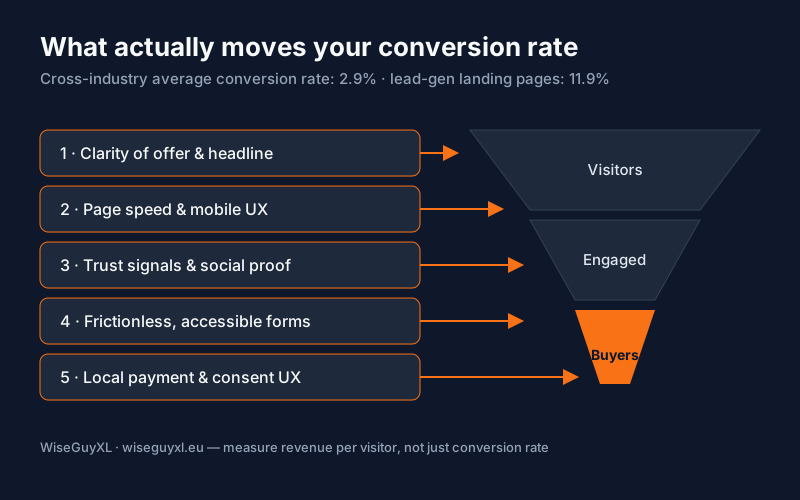
Quick answer: The average website converts about 2.9% of its visitors, and most sites lose the other 97% to the same handful of fixable problems — an unclear offer, a slow or awkward mobile experience, weak trust signals, high-friction forms, and — in Europe especially — a consent and payment experience that gets in the visitor’s way. Conversion rate optimisation (CRO) is the discipline of systematically finding and removing those leaks. You do it by measuring behaviour, forming a hypothesis, testing one change at a time, and keeping only what actually lifts revenue per visitor — not vanity clicks.
This guide gives you the current benchmarks, the five levers worth your time, and the European legal layer that quietly eats conversions if you ignore it.
What is a “good” conversion rate in 2026?
There is no single number, but the benchmarks are stable enough to plan against. Across industries the average sits around 2.9%. Anything in the 2–5% band is respectable, 5%+ is strong, and 10%+ is exceptional. Break it down by model and the picture sharpens:
| Business model | Typical conversion rate (2026) |
|---|---|
| E-commerce (all) | 2.5–3.0% (top quartile ~6.25%) |
| B2B (lead gen) | 2.23–4.31% |
| SaaS (free-to-paid) | 3–5% good, 8–12% great |
| Dedicated lead-gen landing pages | ~11.9% |
| Professional services | ~4.6% |
Two lessons hide in that table. First, dedicated landing pages convert roughly four times better than general pages — sending paid traffic to your homepage is a tax you pay every month. Second, your target should be your own trend line, not an industry average built on someone else’s traffic, offer, and price point.
The CRO loop: how optimisation actually works
CRO is a loop, not a checklist:
- Measure. Combine quantitative data (analytics: where people drop off, which pages leak, device splits) with qualitative data (session recordings, heatmaps, on-site polls, support tickets). The goal is to find where and why people leave.
- Hypothesise. Turn a finding into a testable statement: “Because the checkout asks for a phone number before it’s needed, mobile users abandon; removing it will lift completed checkouts.”
- Test. Run an A/B test if you have the traffic (you generally need a few hundred conversions per variant to reach significance). If you don’t, ship the change and watch a before/after window instead.
- Learn and repeat. Keep winners, document losers, and feed what you learned into the next hypothesis.
The mistake most small businesses make is skipping straight to “test a green button.” Button colour rarely matters. The research step is where the money is.
The five levers that move revenue
1. Clarity of offer and headline
Within about five seconds a visitor should know what you do, who it’s for, and what to do next. Most pages fail here — they lead with a slogan instead of a value proposition. State the outcome (“Get a website that ranks and converts across Europe”), name the audience, and put one primary call to action above the fold. Remove competing CTAs; every extra choice dilutes the main one.
2. Page speed and mobile experience
Speed is a conversion feature, not a technical nicety. Bounce probability climbs sharply as load time passes three seconds, and the majority of European traffic is mobile-first. Compress images, defer non-critical scripts, and test on a mid-range phone on a 4G connection — not on your office fibre. Core Web Vitals remain a useful proxy: fix layout shift and slow interaction first.
3. Trust signals and social proof
European buyers are trust-sensitive and increasingly wary of thin, AI-generated sites. Earn credibility with specifics: real reviews (Trustpilot, Google, and market-native marks like Trusted Shops in Germany/Austria), named case studies with numbers, security and payment badges, a real address and imprint, and named humans behind the business. One caution: the EU’s Omnibus Directive bans fake or undisclosed incentivised reviews, so display only verifiable ones.
4. Frictionless, accessible forms
Every field you ask for costs conversions. Cut the form to what you truly need, use a single column, label clearly, validate inline, and never ask for a phone number “just in case.” Accessibility is now both a legal duty and a conversion win: since the European Accessibility Act took effect in June 2025, many commercial sites must meet WCAG 2.1 AA — and an accessible form (proper labels, keyboard support, sufficient contrast) is measurably easier for everyone to complete.
5. Localised payment and consent experience
This is where European CRO diverges from generic US advice. Two things:
- Payment methods must be local. A German checkout without invoice/SEPA options, a Dutch one without iDEAL, a Polish one without BLIK, or a Belgian one without Bancontact will bleed conversions no headline can recover. Offer the methods your market actually trusts.
- The consent banner is part of the funnel. Under EU/UK rules a compliant cookie banner is mandatory, but a hostile one — walls of text, buried “reject,” pre-ticked boxes — kills trust and conversions and is itself unlawful. Design a clean, honest consent step and wire it to Google Consent Mode v2 so you still model conversions when users decline.
The European legal layer you cannot optimise away
CRO in Europe operates inside a compliance frame. Ignoring it doesn’t just risk fines — it degrades the very trust that drives conversion. Match the layer to your market:
- Germany: DSGVO + § 25 TDDDG (cookies) + BFSG (accessibility from June 2025). Imprint duty (§ 5 DDG).
- France: RGPD/CNIL (CNIL bans dark-pattern consent) + RGAA accessibility.
- Spain: RGPD + LOPDGDD + art. 22 LSSI-CE (cookies), enforced by AEPD.
- Italy: GDPR + Garante + Legge Stanca (accessibility).
- Netherlands: AVG + art. 11.7a Telecomwet (cookies) + AP oversight.
- Poland: RODO + PKE (electronic communications), UODO oversight.
- UK: UK GDPR + PECR (ICO), soft opt-in available for existing customers.
Across the EEA and UK, Google Consent Mode v2 has been mandatory since March 2024 for anyone using Google advertising or measurement. Build consent well and it becomes a conversion asset rather than a liability.
A 30-day CRO starting plan
You don’t need a big budget to start:
- Week 1 — instrument. Install analytics with conversion goals, a heatmap/recording tool, and a one-question exit poll. Confirm Consent Mode v2 is firing.
- Week 2 — find the leaks. Identify your three highest-traffic, lowest-converting pages and watch 20 session recordings of each. Write down every point of confusion.
- Week 3 — fix the obvious. Rewrite the top page’s headline and CTA, cut two form fields, add three real trust signals, and add the missing local payment method.
- Week 4 — test and measure. A/B test your biggest hypothesis if traffic allows; otherwise measure before/after. Track revenue per visitor, not just conversion rate — a change that lifts conversions but lowers order value is not a win.
“Don’t optimize for conversions, optimize for revenue.”
— Neil Patel, co-founder of NP Digital
That line is the whole discipline in seven words. A cheaper offer or an aggressive discount can lift your conversion rate while shrinking your business. Optimise for the number that pays the bills.
Common CRO mistakes that quietly cost conversions
Even well-run sites lose money to a predictable set of errors. Watch for these:
- Testing trivia before fixing fundamentals. Colour and micro-copy tests are seductive because they’re easy, but they rarely move a page that has an unclear offer or a broken mobile checkout. Fix the structural problems first; polish later.
- Optimising the average instead of the segment. Mobile and desktop, new and returning, paid and organic visitors behave differently. A change that helps desktop can hurt mobile. Segment your analysis before you conclude anything.
- Calling tests too early. Stopping an A/B test the moment it looks positive is the fastest way to ship a false winner. Decide your sample size in advance and wait for it, or read a fixed before/after window instead.
- Adding friction in the name of “qualification.” Extra form fields, forced account creation, and mandatory phone numbers feel like they filter for serious buyers. Usually they just filter out buyers. Ask for the minimum, then enrich later.
- Ignoring the post-click experience. A brilliant ad that lands on a slow, generic homepage wastes the click. Match the landing page to the promise that earned the visit.
- Treating the consent banner as an afterthought. A cluttered or manipulative banner is both a conversion killer and a legal risk in the EU. Design it as part of the funnel, not a bolt-on.
The through-line: most conversion gains come from removing things — friction, confusion, unnecessary choices — not adding them.
How to measure whether it’s working
Pick a primary metric before you start, and make it a money metric where you can. Revenue per visitor (or revenue per session) is the cleanest, because it captures both conversion rate and order value in one number. For lead-gen sites where revenue is downstream, track qualified leads per visitor and tie back to closed revenue when you can. Support those with a short list of diagnostics — add-to-cart rate, checkout completion, form-start-to-finish — so that when the headline number moves you know why. Review on a cadence long enough to smooth out daily noise (weekly for high-traffic sites, monthly for smaller ones), and annotate every change you ship so your trend line tells a story you can learn from.
FAQ
How much traffic do I need to run an A/B test?
Roughly a few hundred conversions per variant to trust the result. Below that, test bigger, bolder changes and read before/after windows rather than chasing statistical significance you can’t reach.
Does CRO hurt SEO?
No — done well it helps. Clearer pages, faster loads, and better UX signals align with what search and AI answer engines reward. If you’re rethinking how pages earn visibility, pair CRO with how AEO and SEO are changing in 2026.
Is the cookie banner really costing me conversions?
Yes, if it’s hostile. A clean, honest consent step with a genuine “reject” option preserves trust and keeps you lawful. Consent Mode v2 lets you keep modelling conversions when users decline.
What’s the single highest-ROI CRO fix for a small business?
Send paid traffic to a dedicated, single-goal landing page instead of your homepage. That change alone routinely multiplies conversion rate.
Sources
- Popupsmart, 2026 Website Conversion Rate Benchmarks (citing Ruler Analytics, First Page Sage, Lead Forensics), 2026.
- European Commission, European Accessibility Act (in force June 2025); EN 301 549 / WCAG 2.1 AA.
- Google for Developers, Consent Mode v2 documentation.
- EU Omnibus Directive (consumer review transparency).
- Neil Patel (NP Digital), attributed quote.
Ready to turn traffic into customers? WiseGuyXL builds and optimises websites that convert across Europe — with the local payment, consent, and accessibility layer built in from day one. We’ve driven 341% organic growth across 30+ projects in 9+ markets. Talk to us about your site and see where your conversions are leaking.