
How to Do Keyword Research in 2026 (Including AI-Search Queries)
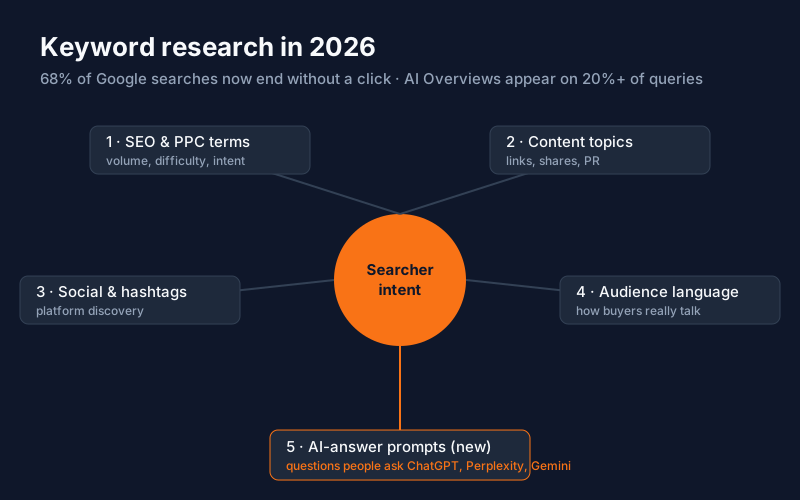
Quick answer: Keyword research in 2026 is no longer just “find high-volume search terms.” With 68% of Google searches now ending without a click and AI Overviews appearing on more than 20% of queries (cutting click-through by nearly 60% when they show), you have to research two things at once: the keywords people type into search engines, and the prompts they ask AI answer engines like ChatGPT, Perplexity and Gemini. The method is the same underneath — understand searcher intent, map it to your business, prioritise by opportunity — but the outputs now include topics and questions you want to be cited for, not just ranked for.
This guide walks the full process, adds the new AI layer, and shows how to do it across Europe’s languages.
Start with the four kinds of keyword research
SparkToro’s Rand Fishkin makes a point most guides miss: keyword research isn’t one activity.
“Keyword research is broader than you might think, friends.”
— Rand Fishkin, co-founder of SparkToro
He splits it into four kinds, and choosing the right one saves you from optimising for the wrong goal:
- Keyword research for SEO/PPC — the search terms people use, prioritised by volume, difficulty and intent, for organic and paid targeting.
- Keyword research for content — topics likely to earn links, shares, email clicks and PR, beyond pure search volume.
- Keyword research for social media — the hashtags, phrases and topics that surface on LinkedIn, Instagram, TikTok and YouTube.
- Keyword research for audience/market research — how your buyers actually talk, what they care about, and the language they use.
Most businesses only ever do the first. The others are where differentiation lives — and in 2026 they feed the AI layer directly.
The classic process, still essential
Before the AI part, get the fundamentals right.
1. Seed and expand. Start with 5–10 seed terms describing what you do. Expand them with a keyword tool (Google Keyword Planner, Ahrefs, Semrush, or a budget option like Keywords Everywhere), Google autocomplete, “People Also Ask,” and related searches. Mine your own search-console data for terms you already rank for on page two — those are the fastest wins.
2. Classify by intent. Sort every term into informational (learn), commercial (compare), or transactional (buy/hire). Intent decides the page type: a blog post for “how to do keyword research,” a comparison page for “best keyword tools,” a service page for “SEO agency [city].” Matching intent is more important than matching volume.
3. Judge the opportunity, not just the volume. A term with 200 searches and clear buying intent beats one with 20,000 searches and none. Weigh volume against keyword difficulty (how strong the ranking pages are), business value, and — increasingly — whether the SERP even sends clicks. Which brings us to the shift.
The 2026 shift: research prompts, not just keywords
Search behaviour has moved. Zero-click results, AI Overviews and standalone AI answer engines mean a growing share of “searches” never reach your site as a click — but they can reach your customer as a citation. So your research now has a fifth layer: the questions and prompts people ask AI engines.
How to research the AI layer:
- Harvest real questions. Pull the exact questions your audience asks — from “People Also Ask,” from Reddit and niche forums, from your sales and support inboxes, and from customer interviews. These long, natural-language questions are what people type into ChatGPT and Perplexity.
- Test the engines directly. Ask ChatGPT, Perplexity, Gemini and Google’s AI Overviews your target questions and note which sources they cite. Those citations are your real competitors now. If a competitor is cited and you aren’t, that’s a gap to close.
- Map questions to citable content. For each priority question, plan a page that answers it cleanly and early — a direct quick-answer, a clear structure, and verifiable facts an engine can lift. This is answer engine optimisation (AEO); if it’s new to you, start with AEO vs SEO: what changes in 2026.
- Track citations, not just rankings. Add “did an AI engine cite us for this question?” to your reporting alongside classic rank tracking.
The underlying skill hasn’t changed — you’re still mapping intent to content. You’re just doing it for a searcher who may never click.
Keyword research across European languages
For a business selling across Europe, the biggest mistake is researching in English and translating. Localise, don’t translate. Search language differs by market in ways translation misses:
- Run research natively per language. Germans search “Webseite erstellen lassen,” not a translated phrase; the French search “création site internet”; Poles search “strona internetowa cena.” Volumes, competition and phrasing are all different.
- Watch for false friends and local terms. Direct translations often have little or no search volume, while the term locals actually use does.
- Respect ccTLD and hreflang structure. Multi-language keyword targeting only works if the site is technically set up for it. Pair your research with the right international structure — see European SEO: multi-country and hreflang how-to.
- Note the EU AI Act transparency layer. If you use AI to help generate content at scale, the EU AI Act’s transparency provisions (phasing through 2025–2026) expect AI-generated content to be identifiable — worth building into your workflow now.
A comparison: keyword vs AI-prompt research
| Classic keyword research | AI-prompt research (2026) | |
|---|---|---|
| Unit | Search term | Natural-language question/prompt |
| Success metric | Ranking + clicks | Being cited in the AI answer |
| Best sources | Keyword tools, Search Console | PAA, forums, sales calls, the engines themselves |
| Length/style | Short, head + long-tail | Long, conversational |
| Where it wins | Traditional SERPs | AI Overviews, ChatGPT, Perplexity, Gemini |
You need both. Do the classic work to capture the clicks that still exist; do the AI work to stay visible where clicks are disappearing.
How to prioritise: a simple keyword scoring model
A keyword list is worthless until it’s ranked. When you have hundreds of candidates, score each one so effort goes where it pays. A lightweight model that works for most European small and mid-sized businesses:
- Business value (1–5): How close is this term to money? A “buy” or “hire” query scores 5; a top-of-funnel “what is” query scores 1–2.
- Intent match (1–5): Do you have — or can you create — the exact page type this query wants?
- Winnability (1–5): How realistic is it to rank or be cited, given who’s already there? Page-two terms you already rank for score high here.
- Click reality (1–5): Does this SERP still send clicks, or is it dominated by an AI Overview and zero-click features? A pure informational query swallowed by AI Overviews scores lower for traffic — but may still be worth targeting for citation.
Multiply or sum the scores and work top-down. This one habit stops the most common failure in keyword research: pouring months into high-volume terms that are either unwinnable or no longer send clicks.
Common keyword-research mistakes to avoid
- Chasing volume over intent. High-volume head terms feel like a prize, but they’re competitive and often informational. A cluster of specific, high-intent long-tail terms usually converts far better.
- Translating instead of researching. Covered above, but it’s the single most expensive mistake for cross-border businesses — real local phrasing rarely matches a literal translation.
- Targeting keywords you can’t win. Ambition is good; ignoring the competition on page one is not. Balance reach terms with winnable ones so you actually get traffic this year.
- Ignoring the SERP itself. Two terms with identical volume can behave completely differently depending on whether the results are ten blue links, a pack of ads, or an AI Overview. Always look at the live SERP before committing.
- Doing it once. Search behaviour, competitors and AI answers all shift. Keyword research is a routine, not a project — which is exactly why the weekly rhythm below matters.
A simple weekly keyword-research routine
- Monday: Export last week’s Search Console queries; flag page-two terms and new question-style queries.
- Tuesday: Expand two seed topics; classify by intent; pick one page to build or improve.
- Wednesday: Run your top five questions through ChatGPT, Perplexity and Gemini; log who gets cited.
- Thursday: For each priority language, verify the native phrasing and volume before writing.
- Friday: Update your tracker with rankings and citations; queue next week’s topic.
FAQ
Do I still need keyword research if AI is answering everything?
More than ever — but the output shifts. You research keywords to capture the clicks that remain and prompts/questions to earn citations in AI answers. Ignoring either leaves visibility on the table.
Which free keyword tools are worth using?
Google Keyword Planner, Google Search Console, Google Trends, autocomplete and “People Also Ask” get you a long way. Paid tools (Ahrefs, Semrush) add depth on difficulty and competitor gaps.
How do I find what people ask AI engines?
There’s no volume tool yet, so triangulate: “People Also Ask,” Reddit/forums, your own sales and support questions, and directly testing the engines to see what they answer and cite.
Should I research keywords in English and translate?
No. Research natively in each language — real local phrasing and volume differ from translations. Localise, don’t translate.
Sources
- SparkToro (Rand Fishkin), There Are Four Kinds of Keyword Research, and 2026 Zero-Click Search Study.
- Search Engine Land, Google zero-click searches reach 68% in early 2026 (SparkToro/Similarweb data).
- Google Search Central, E-E-A-T and helpful content guidance.
- EU AI Act (transparency provisions phasing 2025–2026).
Want your business found by both Google and AI? WiseGuyXL builds multilingual keyword and AEO strategies that earn rankings and citations across Europe — we’ve driven 341% organic growth across 30+ projects in 9+ markets. Start a conversation about your keyword strategy.