
European SEO: A Multi-Country & Hreflang How-To (2026)
Quick answer: To rank across Europe you need three things done right, in order: a clear site structure (one primary choice among ccTLD, subfolder, or subdomain), correct hreflang annotations so Google shows the right language/country version to each searcher, and genuine localisation — real local pricing, local legal wording, and local search intent, not machine-translated copy. Get the structure and hreflang wrong and you split your own rankings; get localisation wrong and you never earn the click in the first place.
Europe is not one market. A Dutch buyer, a Polish buyer and a French buyer search differently, convert differently, and live under different consent and accessibility rules. This guide walks through the architecture decision, the hreflang mechanics that trip up even large sites, and the per-country nuances that decide whether your pages actually rank.
Step 1 — Pick your international site structure
There are three ways to organise multi-country content, and the choice shapes everything downstream.
| Structure | Example | Ranking signal to Google | Cost & effort | Best for |
|---|---|---|---|---|
| ccTLD (country domain) | wiseguyxl.de, wiseguyxl.fr |
Strongest geo-signal; each domain builds authority separately | Highest — buy/maintain many domains, split link equity | Large brands with country teams and budget |
| Subfolder (subdirectory) | wiseguyxl.eu/de/, /fr/ |
Inherits the root domain’s authority; consolidated | Lowest — one domain, one CMS | Most SMEs and agencies (recommended default) |
| Subdomain | de.wiseguyxl.eu |
Treated as semi-separate; weaker equity sharing than subfolders | Medium | Cases with separate hosting/infra per region |
For most European SMEs and agencies, subfolders on a single strong domain are the pragmatic winner: you concentrate authority instead of fragmenting it across a dozen ccTLDs, and you can add a market by adding a folder. ccTLDs earn the clearest local trust signal and can be worth it once a country is a serious revenue line — but each new domain starts its authority from zero. WiseGuyXL’s own site uses the subfolder model (/de/, /fr/, /es/, /it/, /nl/, /pl/) for exactly this reason.
A note that surprises people: .eu is a valid ccTLD-style signal for “Europe” but not for any single country. It won’t tell Google you’re targeting Germany specifically. That’s fine when your structure and hreflang do the country-level targeting for you.
Step 2 — Understand what hreflang actually does (and doesn’t)
Hreflang is an HTML annotation (or HTTP header, or XML-sitemap entry) that tells Google: “this page has equivalent versions in these other languages/regions — serve the right one to the right user.” It does not boost rankings and it does not stop duplicate-content issues by magic. What it does is prevent the wrong version showing to the wrong searcher, and prevent your German and Austrian pages from cannibalising each other in the SERP.
“Hreflang is one of the most complex aspects of SEO (if not the most complex one).” — John Mueller, Search Advocate at Google
Mueller isn’t exaggerating. The rules are unforgiving, and one broken value can void an entire cluster.
The rules that matter
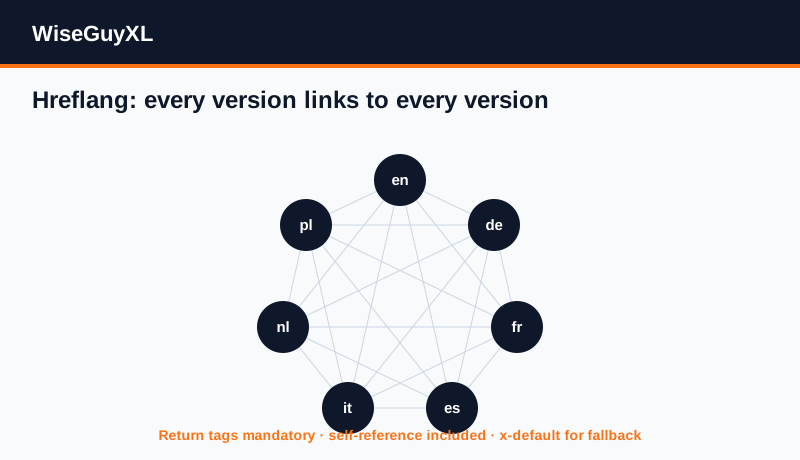
- Return tags are mandatory. If page A links to page B with hreflang, page B must link back to A. Missing return tags is the single most common error — Google simply ignores non-reciprocal annotations.
- Use the right codes. Language is ISO 639-1 (
de,fr,nl); optional region is ISO 3166-1 Alpha-2 (de-AT,fr-BE,nl-BE). Language comes first, region second.en-UKis wrong — the country code for the United Kingdom isGB, so it’sen-GB. - Every page in the set references every version, including itself. A five-language cluster has five self-referencing entries on each page.
- Add
x-defaultfor a fallback/selector page when no listed version fits the user (e.g. an international landing or language picker). - URLs must be absolute and indexable. Don’t point hreflang at redirected, canonicalised-away, or noindexed URLs.
- Keep canonicals self-referential per version. A common disaster: every localised page canonicalises to the English one, so Google drops all the translations. Each language version’s canonical should point to itself.
Where to put hreflang
You can implement it three ways — pick one and be consistent:
- HTML
<head><link>tags — easiest to audit, but heavy on very large sites. - XML sitemap
<xhtml:link>entries — scales best for thousands of URLs, keeps markup clean. - HTTP headers — for non-HTML files like PDFs.
For a typical agency or SME site, HTML tags in the head are the most transparent and the easiest for a reviewer to verify.
Step 3 — Localise, don’t translate
This is where European SEO is won or lost. Translation swaps words; localisation swaps substance. A page that says “£1,500–£5,000” converted mechanically to “€1,750–€5,850” is both wrong and untrustworthy — you never convert currency, you research the real local rate. WiseGuyXL’s rule across every market is: replace figures with genuine local data, swap the legal layer for the country in question, and translate quotes faithfully.
What changes per market:
- Currency and price expectations. Poland prices in złoty, the UK in pounds, the Eurozone in euros — and the level differs too, not just the symbol. Web-development and SEO retainers in Warsaw are not Munich rates.
- Search intent and phrasing. Germans search “was kostet…”, the French “combien coûte…”, and the keyword volumes and modifiers differ. Do keyword research natively in each language rather than translating your English keyword list.
- The legal/consent layer. Cookie, privacy and accessibility wording must match the country: DSGVO + § 7 UWG (Germany), RGPD/CNIL + RGAA (France), LOPDGDD (Spain), the Garante’s rules (Italy), AVG (Netherlands), RODO (Poland), UK GDPR + PECR (UK). Since June 2025 the European Accessibility Act applies EU-wide, so accessibility statements are now part of proper localisation, not an afterthought.
Step 4 — Geotargeting and technical hygiene
- Search Console country targeting is legacy for ccTLDs and gTLDs alike — for subfolders, hreflang plus genuinely localised content carries the signal. Don’t rely on the old “International Targeting” report as your main lever.
- Server location and CDN barely matter for ranking now, but page speed does — use a CDN so a Polish user isn’t served from a slow Frankfurt-only origin.
- Local backlinks still count: a
.plpublisher linking to your Polish folder is a stronger local-relevance signal than another English link. - Currency, dates, and units should render in local format — €, zł, £; DD.MM.YYYY where appropriate.
Common hreflang mistakes that quietly kill rankings
- Missing return tags — the number-one error; annotations are ignored entirely.
- Wrong or invented codes —
en-UK,de-DE-formal, region-only tags with no language. - Pointing at redirected or noindexed URLs — the target must be the live, indexable, self-canonical page.
- Mixing implementation methods — HTML tags and sitemap entries that disagree.
- Canonicalising all versions to English — silently de-indexes every translation.
- Treating hreflang as a ranking booster — it isn’t; it’s a routing instruction. You still need the localised content to be good.
Audit with Search Console’s coverage and (where still surfaced) international reports, plus a crawler like Screaming Frog or Sitebulb that flags non-reciprocal and invalid annotations.
FAQ
Do I need hreflang if all my pages are in English?
Only if you target different English-speaking regions (e.g. en-GB vs en-IE) with meaningfully different content. If there’s one English page for everyone, you don’t need it.
ccTLD or subfolder for a European rollout?
Subfolders for most SMEs and agencies — one domain, consolidated authority, cheap to extend. Move to ccTLDs only when a country is a large, resourced revenue line.
Does hreflang fix duplicate content across countries?
It helps Google understand the versions are equivalents rather than duplicates, so it serves the right one. It’s not a substitute for canonical tags or genuine localisation.
How long until hreflang takes effect?
Google has to recrawl every page in the set, so allow weeks, not days — larger sites longer. Nothing changes until the whole cluster is recrawled.
Is .eu good for European SEO?
It signals “Europe” but not any single country, so it must be paired with correct hreflang and localised subfolders to target specific markets.
Sources
- Google Search Central — hreflang and international-site documentation.
- Search Engine Journal — common hreflang mistakes and audit methods (2026).
- Oban International; Impression Digital — ccTLD vs subfolder vs subdomain analysis.
- Born Digital; DigitalApplied — International SEO & hreflang guides for EU businesses (2026).
- European Accessibility Act (in force June 2025) — per-country transposition.
Ready to rank across Europe — properly?
WiseGuyXL builds multi-country, multilingual SEO that survives Google’s quality bar and gets cited by AI answers — real localisation, correct hreflang, correct legal layer per market. That approach has driven 341% organic growth across 30+ projects in 9+ markets. See how we cost SEO, compare programmatic SEO pricing, or read the questions to ask any SEO agency before you hire. More on the WiseGuyXL blog.
Author: WiseGuyXL Editorial. Researched and drafted with AI assistance; reviewed by a human editor before publication.
1 thought on “European SEO: A Multi-Country & Hreflang How-To (2026)”